Wednesday, November 24, 2010

Week 5: Miscommunication of a Nonverbal Message


 Introduction
As a substitute teacher I constantly find myself deciphering nonverbal messages from students.  I feel that because of all the exposure to student’s nonverbal cues, I’ve become fairly advanced at reading their thoughts.  But every now and then, I come by a student who teaches something new.  And I learn again and again that students all behave differently for particular reasons.
Gym Class
            This past week, I was hired to teach a gym class for an elementary school.   As I read over the teacher’s notes, I quickly realized that every student was encouraged to participate and that no one was to sit out.
            The morning started off well; a few students, here and there, asked to sit out because their stomach’s hurt, but I was able to convince them to participate.  So far I had accomplished the teacher’s instructions and was able to report back of complete class involvement.  The afternoon, for the most part, worked in the same fashion.  It wasn’t until the late afternoon, that I had trouble with a certain female student.
            As she walked in the gym, I noticed she was a little chubbier than her classmates.  She didn’t speak much to her fellow classmates and carried a look of timidity on her face.  As her class began to stretch, she walked over the steps of the gym and sat down.  Not saying a word, I closely watched over her for the next few minutes as her classmates continued stretching.  She sat with her hands crossed and pretended that she was listening to music, bobbing her head from side to side.
            At first thought I read the girl to be self-conscious of her physical capabilities (because of her size) and that was the reasoning for her actions.  I then walked over to her and quietly explained that if she did not participate in warm-up that she would not be allowed to participate in gym at all that day.  She didn’t seem too upset by it and shrugged her shoulders. 
At second thought, I imagined this had become a common conversation between her and her everyday gym teacher (Hints to the teacher’s instructions).  After that, I told her it was her choice: she could either participate or go to the office.   She reluctantly got up, stomped toward her classmates and began stretching.
            At the end of the day, I went to check out with the front office and told them of this particular student.  I figured that because the girl was a little chubbier, she was shy and did not want to participate and therefore decided to put on an act in order to get out of class.  The front office attendant informed me that this was very unusual behavior for this child and that she usually is very active with her classmates.  I later found out that the night before I taught, her father was arrested.  She was upset the entire school day and was merely acting out for attention purposes.
Conclusion- Lesson Learned
            I quickly learned from this misinterpretation of nonverbal messaging that every student reacts to change in a different manner and I should never try to assume I know why they act a certain way.
            Nonverbal messages can be confusing at times.  And I believe it is best to learn from each misinterpretation to better prepare one’s self for the next occurrence. 


Week 4: My Identity


 Introduction
            Have you ever felt the need to fix anything and everyone in your life that is ‘broken’ or in need of guidance?  I have.  On many occasions I have been called “The Finder of Lost Things,” “Tech-Support,” “A Problem-Solver,” and “Miss Fix-it.”  With these many titles, named by friends and family, I have come to the realization that I have a similar identity to one of a “Savior”.  I find myself constantly feeling the need to save or help someone, whether it be a technological, personal, or advising issue/problem. 
            I realize I have been doing this all my life.  When I was younger I would walk around with tools trying to see if our house needed any repairs.  I also would try to act like a psychiatrist around my friends (as if an eight-year-old could give good advice).   Basically, if there was something I could help with, I was there.

My “Savior” Identity
            At first, I didn’t realize that my “Savior” identity was any different than others.  I thought the way I acted was the ‘norm’ and that others acted in the same manner.  But as I grew older, I soon realized that other people did not share the same type of identity.  I learned that some people were the “Saviors” and others were “in need of saving.”
            As many times as I have found my “Savior” identity wanting to help, the most prominent instant that sticks out in my mind happened a little over a year ago.
 
Since that day, I have found myself working closely with two different types of therapy techniques.
  • Cognitive therapy: focusing on trying to change a person's negative thinking and the inaccurate perceptions they have of themselves and their environment. People are taught to think logically, and to avoid negative self-talk.
  • Interpersonal therapy: teaching a person how to successfully interact with others. Depressive illnesses interfere with how a person treats their family, friends, and co-workers, which affects how they treat them in return. Interpersonal therapy focuses on social skills.
(SAVE, 2010)

I know the conclusion to this type of story wouldn’t normally end successfully, so I feel very grateful to have had this type of identity, especially in this situation. 

The Good & Bad

                On one end, I personally feel a sense of accomplishment when I can help someone 

work through a problem.  (It is great to know that I have been able to better someone’s life.)

But on the other hand, my “Savior” identity does leave me feeling a sense of failure every now

and then. Every so often, I am in a situation where I cannot ‘fix’ a problem and I am left 

feeling defeated. 


Not Everyone Agrees
            As helpful and important as I view the “Savior” identity,  I have found out that not everyone agrees with me.  Sometimes people have found my “Savior” identity as nosey and pushy.  On instances, I have been told to butt-out and to keep opinions to myself.  Now, I’ve never found myself to be either one of these things, and I find it frustrating that people would think of my identity in this manner.  My only desire has been to help others and not to pry. 
            I have found it is best to communicate with “Non-Savior” identities by first identifying my role in the conversation and then proceed from there.  If I make a point prior to the conversation as to my intentions, I will have a better chance of not being misinterpreted and misunderstood.
When speaking with other “Savior” identity types, empathy plays a large role in communication.  Because we are more similar in views and roles, communication seems to work more efficiently in this manner.
Conclusion
Our book states “how we behave and communicate to others helps construct our personal identity” (Martin and Nakayama, 2011, pg 111).    I believe the way I carry myself coincides with this statement.  My “Savior” identity is constructed by my personal efforts to strive for the best in everything. 
      •As a coach, I do my best to lead my team to success. 
      •
As a family member, I do my best to be there for anyone in need. 
      •
As a student, I do my best to strive for personal excellence. 
      •
And as a friend, I do my best to listen and give advice accordingly. 

With all of these things, I believe that my “Savior” identity plays a large role in my life.  And 

without it, I would feel incomplete.


Lyrics from “How To Save A Life”
(The Fray, 2005)


References 

Martin, Judith N. and Thomas K. Nakayama. Experiencing Intercultural Communication. 4th.New York: McGraw-Hill, 2011. 

SAVE. Suicide Awareness Voices of Education. 2010. <http://www.save.org/index.cfm?fuseaction=home.viewpage&page_id=705c8cb8-9321-f1bd-867e811b1b404c94>.


The Fray. "How To Save A Life." how to save a life. Sony Music Entertainment, 13 09 2005.


Week 3: History Analysis

1.   Why would it be important to examine the role of history in Intercultural Communication?
                Culture and cultural identities are intimately tied to history, as they have no meaning without history (Martin and Nakayama, 2011, pg 68).  With so many different cultures in the world, it is important that people understand and respect the fact that their culture’s history may not be the same as someone close to them.  A person’s history may speak a lot about their personality and be helpful in identifying proper communication styles and techniques.
Especially in the business world, it is extremely important to examine the history of hopeful future clientele.  If a company has a better understanding of where their client’s history and directive influence come from, a person can better prepare themselves with a sales pitch.  For example:  In the United States, it is proper to maintain direct eye contact when speaking with someone.  In Zimbabwe, however, it is considered rude to maintain eye contact while conversing (Wu, 2011).   So, if an American business is wishing to do business with Zimbabwe, they must make sure they are aware of their cultural gesture differences before they ever meet in person.

2.   What are hidden histories and how might hidden histories affect intercultural interactions?
In a nutshell, hidden histories are histories that typically are not conveyed in a widespread manner (Martin and Nakayama, 2011, pg 87).  When looking more into the term, I began researching online and found out that some Canadians are actually trying to teach readers about one of their hidden histories called The Canadian Holocaust… who knew? 
If you’d like you read about The Canadian Holocaust visit: http://www.hiddenfromhistory.org/
 I have also come to understand that not only do countries have hidden histories but people may as well.  For example, in many adoption cases medical backgrounds are hard to trace, leaving the child without an accurate medical history.  My mother, for example was adopted shortly after she was born.  Her fraternal mother was unaware of her own medical background so when she was adopted by my grandparents they were unaware of her complete history.  To this day, my mother is still completely unaware of her fraternal family’s cultural background.  And much like my mother’s case, when people adopt from other cultures, they may undergo similar complications. Therefore, a hidden history can subsequently hurt or alter future planning and/or decisions, especially with intercultural communication.  (i.e. If a country is unaware of their other country’s business partners faulty history, they run the risk of damaging their own company.)

3.   Compare and contrast family histories with national histories.
As we have learned, a single person takes part in many different cultures throughout their lifetime; and within each culture a history is created.  Much like other cultural histories, national and family histories rely on the spread of communication.  If it were not for the generations of people recreating and retelling tales of greatness and traditions, histories would be lost and forgotten.  National and family histories also may also differ from other national or family histories, making them somewhat unique to their cultural members.
Even though these two histories appear similar, they could not be more different.  A national history is much more widely known and embraced by all of its nation’s inhabitants.  It is made up of great events/important figures from events in which the nation has deemed of great importance.  Many people, within the nation, learn of their national history through school books and historical narratives.  On the other hand, family histories occur at the same time as other histories but on a more personal level.  They are made up of special moments and influenced by every family member.  In most cases, they are not written down, but are passed along orally from one generation the next (Martin and Nakayama, 2011, pg. 70).

4.   How is the history of gays and lesbians relevant to intercultural communication?
Our book states, “sexual orientation histories emphasize the significance of sexuality in understanding the past and the present, yet these histories are often overlooked or silenced” (Martin and Nakayama, 2011, pg 77).  This statement is very true.  History of sexual orientation has often been overlooked; take Abraham Lincoln for example.  Did you know that President Abraham Lincoln was/is rumored to have had homosexual tendencies?  A recently published book, entitled The Intimate World of Abraham Lincoln written by C.A. Tripp, takes an in-depth look at Lincoln’s life and explores his changing sexual orientation throughout his lifetime.  This book shocked many people when it first came out, as they were unaware of President Lincoln’s hidden love life.  However, considering they did not have the titles of ‘gay’ and ‘lesbian’ back in his time, Lincoln cannot be accurately be identified as gay by today’s standards.  (And regardless to his orientation, Lincoln is remembered for his great work.)
I believe the overall importance in knowing the history of gays and lesbians is primarily for the purpose of other cultures acknowledging its existence.   Within intercultural communication, a person is most likely going to work with someone of a different sexual orientation.  And by a person learning about the histories of different sexual orientations, they broaden their awareness and possibly become more accepting of current or future co-workers.

5.   How can we negotiate histories in interactions?
“The desire to escape history is significant in what it tells us about how our own culture negotiates its relation to the past and how we view the relation of other nations and cultures to their pasts” (Martin and Nakayama, 2011, pg. 75).  By learning about other culture’s histories, we give ourselves a better understanding to the world around us and increase the chance for successful intercultural interaction. 
For example:  Recently my family and I traveled abroad to Paris, France for a vacation.  Prior to our trip we were aware that the French culture was not fond of our American culture, so in our careful planning we planned to stay in the areas that would be deemed as “tourist friendly.”  By having prior knowledge of the French history and culture, we were able to negotiate our trip successfully and interact with French people who were more welcoming to tourists.

References

Hidden From History. Hidden From History: The Canadian Holocaust: The Untold Story of the Genocide of Aboriginal Peoples. 2008. <http://www.hiddenfromhistory.org/>.

Martin, Judith N. and Thomas K. Nakayama. Experiencing Intercultural Communication. 4th. New York: McGraw-Hill, 2011.

Tripp, C. A. The Intimate World Of Abraham Lincoln. Free Press, 2005.

Wu, Charlene. Cultural Gestures. 2010. <http://soc302.tripod.com/soc_302rocks/id6.html>.

Sunday, October 31, 2010

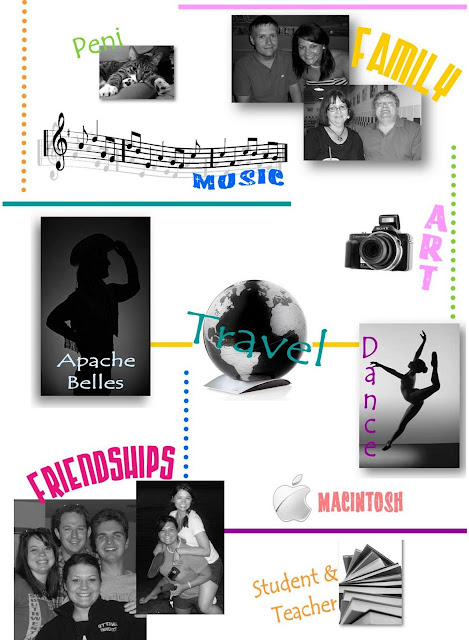
Week 2: Cultural Collage

My cultural collage represents a mixture of what I feel best describes me. 

(The cultures starting from top left:) 
*Peni (my cat) is pictured to represent the culture of pet owners

*The next few pictures are to represent the cultural aspect of family
*The music staff represents my love of music
*Apache Belles was my college sorority. so it plays a major part of my culture as well
*The camera represents different types of arts (photography, design)
*I travel any chance I get, so the globe represents all of my travels
 *Dance has played a major role in my career
*Friendships, of course, help signify certain cultural thoughts and ideals
*The Macintosh apple  represents my love of technology
*The books represents my cultural roles of a student, as well as a substitute teacher & coach


Sunday, October 24, 2010